
Brand film
Launch a Studio With a Widescreen Still
The debut card reads as a film frame — anamorphic crop, considered grade, wordmark small in the lower third.
Teal-orange split-tone, crushed blacks, halftone grain, and a single line of editorial type — for pages where the atmosphere is the message, not the photograph itself.
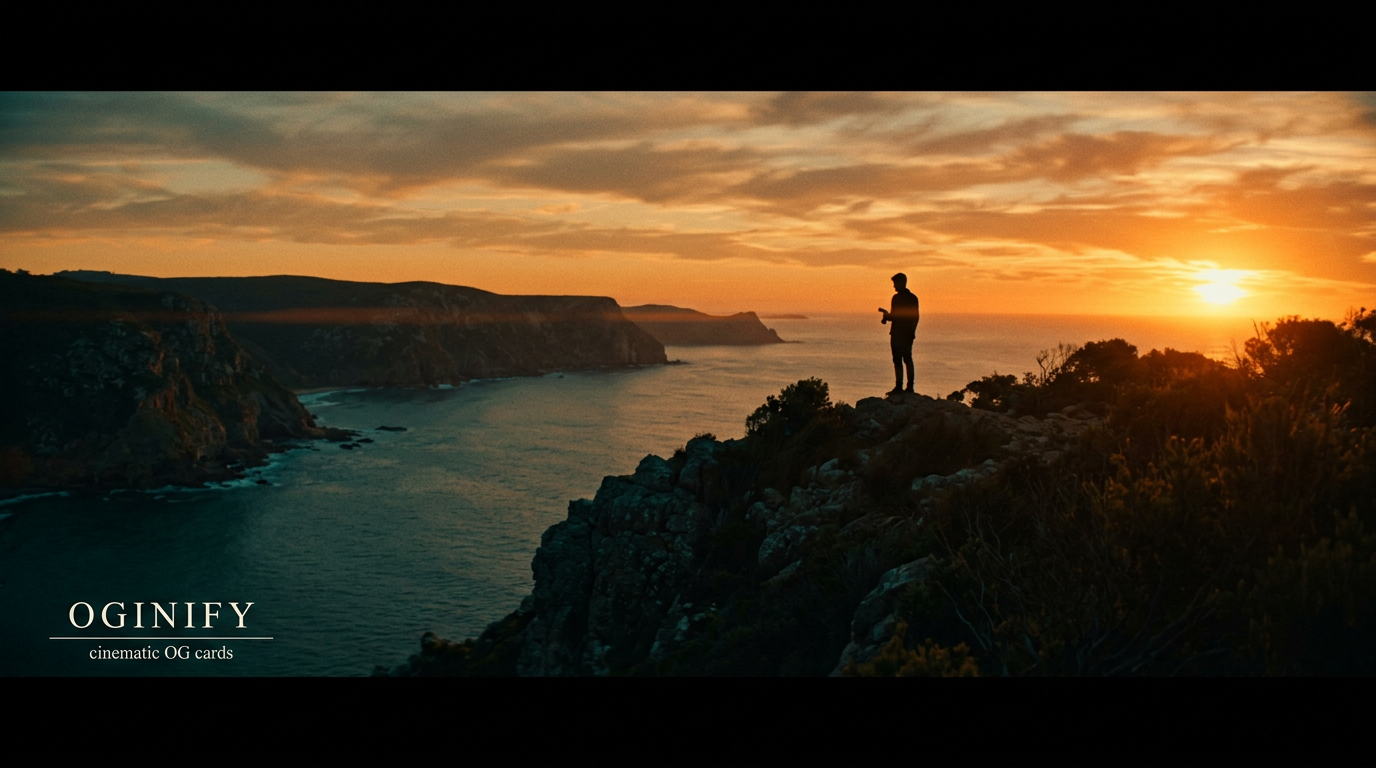
Cinematic isn't text overlay with a filter on top. The graded photograph, the crushed blacks, the single editorial line of type — each one is a deliberate choice, and the alternative is a different conversation. We cover the language, the brands fluent in it, and when to pick it over plain text overlay.
Teal-orange split-tone (shadows pushed to cyan, highlights to amber), crushed blacks (lift ≈ 0, shadow γ < 1), subtle halftone or 35mm grain across the frame, a soft vignette dropping the corners 15-20%, and a single short editorial headline in a serif or wide sans, usually anchored to the lower-left. One mood, one headline, one grade — never two.
Apple's product films open with this exact grade. Linear's anniversary recaps lean on cinematic for brand-film moments. Nothing's launches live here. Arc's brand pages move between text-overlay and cinematic depending on whether they want the photo raw or graded. Off Brand and Studio Output ship it as a default for client pages.
Same skeleton — photo plus white type — but cinematic re-grades the photo as the protagonist (split-tone, grain, vignette) and treats the headline as a film title, while text overlay leaves the photo raw and uses a gradient mask plus headline to add legibility. Pick cinematic when mood is the message; pick text overlay when the literal photo is the proof.
Launch · v3 is live
Most launches read as press releases. A cinematic launch card reads as a film title — the product photograph graded into teal-orange, light grain across the frame, a single short headline anchored lower-left. The card promises a story before the visitor opens the page.
Manifesto · the case for
Manifesto essays live or die on the share preview's gravity. A cinematic frame — sky, hands, the back of a desk lamp — graded warm and grainy, with a 4-word headline set in a high-contrast serif, lifts a text post into something that feels worth 8 minutes of reading.
Year in review · 2025
Annual recaps and milestone changelogs benefit from looking back rather than shipping forward. A cinematic grade across an archive photograph — early prototype on a desk, first office, hand-written notes — gives those posts the texture of a documentary still rather than a marketing brief.
Portfolio · selected work
Studios that sell on taste need share previews that read as taste. The cinematic grade does that work for them: a graded hero shot of the work, light vignette, single italic serif headline. The card is the trailer, the page is the film.
Widescreen crop, considered grade, a single line of type — cinematic OG signals a brand that cares about tone.
Brand film
The debut card reads as a film frame — anamorphic crop, considered grade, wordmark small in the lower third.
Feature
Feature essays under a cinematic card read as culture, not blog posts — the treatment upgrades the piece.
Case film
Agencies producing brand films share the case URL under a poster-styled card that carries the film dominant frame.
Series
Recurring cinematic columns earn recognizability the same way film series do — same crop, same type, fresh still.
Cinematic cards borrow film-poster grammar — wide aspect, cool key light, title lockup at the bottom — so a share feels like a trailer thumbnail.
Even inside the 1200×630 canvas, letterbox the composition to a 2.39 crop; the black bars are what signal 'moving image' before the eye reads type.
One directional light source, low key, cool tones; no flat overhead lighting. Cinematic cards imply a shot, not an illustration.
Title, subtitle and one credit line stack in the lower third; the upper two-thirds carries mood, the lower carries billing.
BrutalistSwiss minimalMagazine editorialTerminal / CLINeo-brutalistText overlayCollageRisograph
Teal-orange split-tone OG cards with crushed blacks and halftone grain.
Teal-orange split-tone color grade, crushed blacks (no true 0,0,0 — always slight blue), halftone grain overlay, and a widescreen photographic composition. The look Blade Runner, Denis Villeneuve, and Christopher Nolan trailers use. Applied to Open Graph cards: mood over information density.
For manifestos, brand films, anniversary recaps, product launch teasers — anywhere the mood of the image matters more than the literal subject. Skip cinematic for docs, pricing and comparison — those need information density, and cinematic prioritizes atmosphere over legibility.
A24 (canonical), Framer for product launches, Loom's brand film pages, most agency showreel unfurls, and the launch pages of consumer products that lean on emotional positioning (Arc Browser, Airbnb 2024 rebrand pages). Not common on B2B; very common on consumer + culture.
Yes — the grain is added at 300dpi source then downsampled, so the platform's recompression preserves the texture rather than destroying it. Cards exported without grain feel plastic at feed scale; the grain is the tell that the card is intentionally cinematic vs. accidentally muddy.
Legible for photo-forward compositions with minimal type (2-3 words max). Cinematic with dense headlines reads as muddy — the split-tone reduces contrast between type and background. Reserve cinematic for cards where the photo is the payload and the copy is a tag.
Text-overlay is universal: any photo + bold white type + dark gradient mask. Cinematic is opinionated: specific color grade, specific grain, specific mood. Text-overlay works for every industry; cinematic works for culture, creative and consumer brands committed to the aesthetic.
Paste any page URL and Oginify generates four 1200×630 cinematic cards in seconds — split-tone grade, halftone grain, single editorial headline. A/B-ready, no signup.