
Portfolio
Debut a Studio With an Issue-One Cover
A new shop launches with a card that reads as issue one — masthead across the top, hero image, dateline underneath the title.
Serif display headlines, an issue-number kicker, a left-margin byline rule, and generous photographic space — the editorial direction for stories meant to be read, not skimmed.
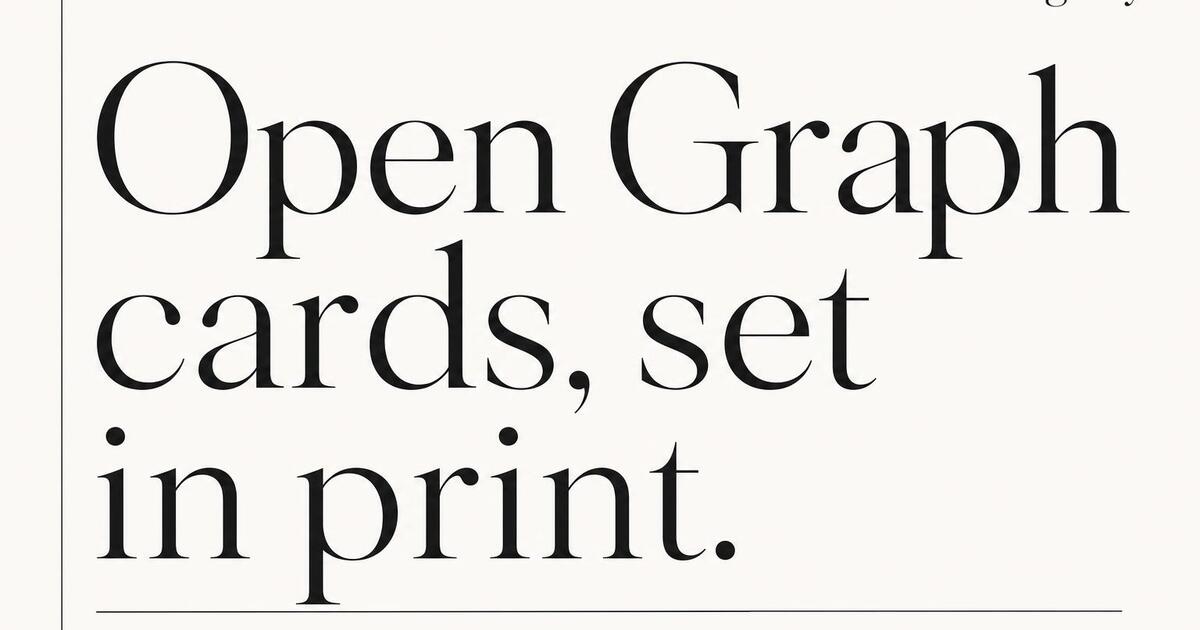
Magazine and Swiss both descend from mid-century editorial design — but a magazine card and a Swiss card read very differently in feed. Here are the typographic moves that signal magazine, the publications using it now, and the precise point where it stops being Swiss.
Serif display in the headline seat (Tiempos, Canela, Domaine, GT Sectra). Drop caps opening long-reads. Multi-column body. Oversized issue or article numbers as anchors. Hairline rules between sections. Photography-first hero. ALL-CAPS small kickers in tracked sans. Color is editorial — one ink, one paper, one accent.
The New Yorker turns every article page into a magazine spread. Pitchfork's review template made the giant numeric score into iconography. Bloomberg and T Magazine treat the web as a print issue. It''s Nice That and Are.na''s editorial both ship the same serif-and-rules grammar across long-form features.
Both heritage editorial systems, opposite voices. Swiss is sans + grid + neutral — neutral typography that disappears so the product speaks. Magazine is serif + columns + voice — typography is the author, and the layout argues a tone. Pick magazine for narrative essays, manifestos, and long-form launches; pick Swiss for product, pricing, and docs.
Long-form essay
A 4,000-word essay needs a card that reads as 'worth twenty minutes', not 'three-minute think piece'. Magazine sets the headline in tall serif display type, the byline below a thin rule, the kicker above as an issue mark. The card itself slows the scroll — and a scroll-slowing card is the only kind that wins the click on long-form.
Newsletter issue · 47
Newsletter issues are a publication, not a content stream. The Magazine preset puts an issue-number kicker on every card so subscribers — and the people they forward issues to — recognize the publication across every share. Substack and Beehiiv newsletters in particular outperform when the cards read as a publication.
Feature story
Feature stories live or die on the headline and the hero photograph. Magazine cards hand both the full stage — generous photographic space above, journalistic display headline anchoring the page — exactly the visual system readers know from print weekend supplements. The unfurl earns the click on its own; the article does the rest.
Op-ed · positioning
Op-ed pieces need to surface the writer's voice, not the publication's brand. Magazine uses a pull-quote layout — a fragment of the strongest sentence in display type, the byline below, the publication mark small at the top. Half quote card, half publication cover, and the recipient knows which writer they're about to read before they tap.
Cover treatment travels well — it earns attention in feeds trained on generic banners.
Portfolio
A new shop launches with a card that reads as issue one — masthead across the top, hero image, dateline underneath the title.
Feature
One dominant image, tight headline, byline in caps — the card reads as an editorial cover, not a blog post.
Client feature
Agencies packaging client work as case features ship the case URL with a cover-styled card — dateline and all.
Issue
Issue 018, Issue 019 — numbering the recurring share turns it into a collectible visual moment.
Editorial cards borrow print grammar — masthead, deck, byline, folio — so a share reads like a spread the reader missed on the newsstand.
Publication mark and section title top of frame, hairline underneath; that row is the print signal readers unconsciously look for.
Long-form serif or high-contrast display H1 as the deck; two lines maximum, never centered — flush-left reads as editorial, centered as marketing.
Author name and issue folio bottom of frame in mono; the folio is what turns the card from decoration into a specific object in a series.
BrutalistSwiss minimalTerminal / CLINeo-brutalistText overlayCinematicCollageRisograph
Editorial magazine-style Open Graph cards with serif headlines and image-led layouts.
A layout system taken from print magazines: serif headline set at 5-8% of the card height, one dominant photographic image (usually full-bleed on one side), a kicker bar or section label above the headline, and a grid gutter that gives the composition editorial rhythm. The New Yorker, Wired, and Monocle all use variants.
For long-form article publishers, essay-heavy blogs, thought-leadership content, brand journalism programs, and B2B companies with a strong editorial voice. Skip magazine for e-commerce (too static) and dev tools (too formal); use it where the article IS the pitch.
The Verge, Wired, New York Times Magazine, Stratechery, Substack's discover pages, The Pudding, most Cloudflare and Stripe editorial content, Every.to, Not Boring. Search their HTML for og:image and you'll see the serif+kicker+full-bleed-photo pattern repeat.
Poorly. Magazine cards are built for headlines that carry weight ('The Race to Reinvent the Cargo Ship' works; 'Weekly Update #47' doesn't). For short-form and social-first content, terminal or Swiss cards land better. Match the style to the article length and gravity.
Magazine is single-story-forward with lots of whitespace and a serif hero. Newspaper is multi-story-forward with dense type, datelines and grid density. Magazine feels premium; newspaper feels urgent. Pick based on whether your content is 'feature' (magazine) or 'report' (newspaper).
Yes. The layout rules (kicker + serif headline + photo grid) are baked into the style; the generator swaps the copy and photo while preserving the composition. Editors regenerate on headline changes in seconds without touching a design tool.
Paste any post URL and get four Magazine-style 1200×630 Open Graph cards in seconds. No signup.