
Attitude
Launch a Brand That Rejects Bland
New brand refusing the SaaS beige palette? The card is a saturated slab with a wordmark that is louder than the noise around it.
Cream paper, hard offset shadows, sticker-pop highlight blocks, and mac-window chrome — the warm cousin of brutalism that PostHog and Gumroad turned into a default.
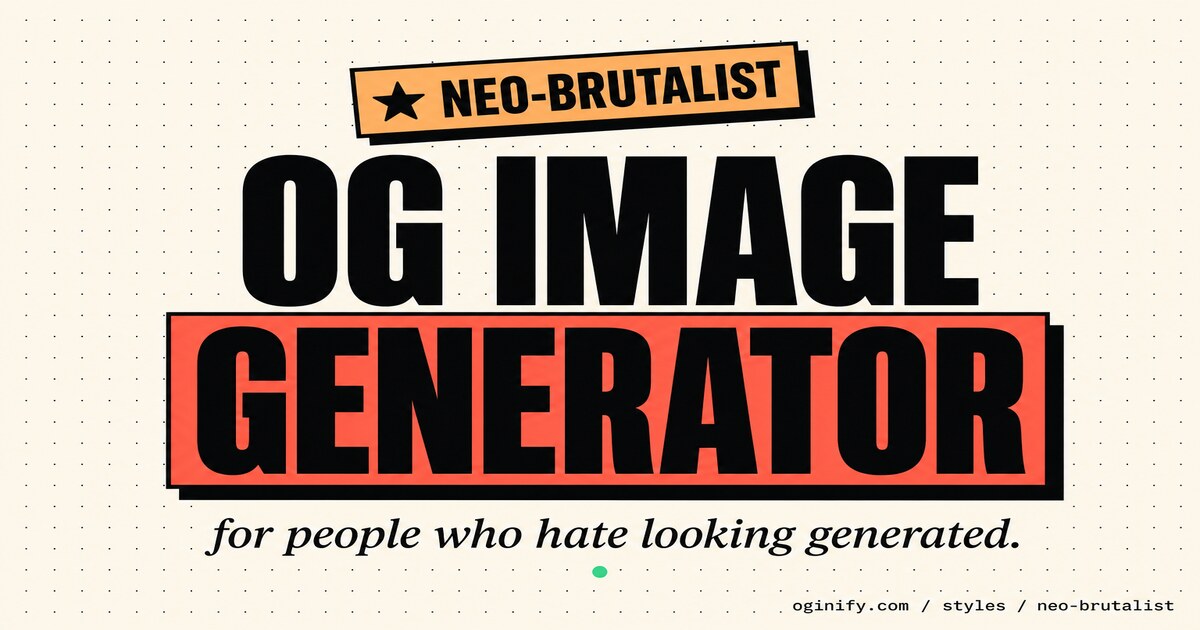
PostHog, Gumroad and Linear made neo-brutalist the default house style of 2026 SaaS, but the look gets confused with its harder-edged parent every day on Twitter. Three sections below: the signature moves, the brands shipping each register, and where the two actually diverge.
Cream paper canvas (#FBF7EE-ish, never pure white), hard black offset shadows with zero blur, coral / mint / peach sticker blocks highlighting key words, tilted ★ FREE TOOL paper badges, 3–4px black outlines on every card, monospace micro-labels, and mac-window dots used as decoration rather than UI.
PostHog runs the loudest version — tilted stickers, hand-drawn callouts on every chart. Pictify built its whole image-card tool in the same language. Resend uses cream + sticker accents across docs. Cal.com sprinkles neo-brutalist blocks in marketing. Gumroad's checkout still anchors the look.
Same skeleton, opposite mood. Classic brutalist is raw black + one neon, designed to confront. Neo-brutalist keeps the borders and flat shadows but swaps black for cream and neon for pastel sticker blocks — the result reads handmade rather than aggressive. Pick neo-brutalist for product-led growth and friendly launches; pick brutalist for manifestos.
Launch · v3 is live
Launch links live or die on the first scroll. Neo-brutalist makes that scroll-stop unambiguous: cream paper, a coral highlight block behind the launch verb, a tilted ★ NEW sticker in the corner. Pair it with a verb-headline ("v3 is live", "Series A", "Winter Drop") and the card reads like a stage cue, not a sales asset.
Free tool · OG image generator
Free tools earn clicks by looking generous, not gated. A tilted ★ FREE TOOL sticker over a mac-window mockup is the genre's entire visual contract — PostHog and Pictify run the same playbook. Neo-brutalist gives free-tool pages a card that previews the offer instead of describing it.
Changelog · shipped this week
Engineers read changelogs in muscle memory. Neo-brutalist turns that grid into something share-worthy: numbered monospace tiles (01 / 02 / 03), one tile highlighted with a mint block, hard 4px black borders. The format reads as a release page first and a graphic second.
Portfolio · studio / folio 2026
Independent studios share work through link previews more than through their actual sites. Neo-brutalist's tilted serif wordmark over a peach highlight bar, plus a hard-shadowed thumbnail card, reads as confident and hand-built. It says "a designer made this" without writing the word designer anywhere.
Chunky borders, saturated blocks, deliberate ugliness — the treatment demands eyes. Send it where you want them.
Attitude
New brand refusing the SaaS beige palette? The card is a saturated slab with a wordmark that is louder than the noise around it.
Opinion
A strident opinion post deserves a card that dresses the part — thick borders, blown-up type, no polite margins on the edges.
Feature
The feature name in Space Grotesk on a shocking-yellow block reads as a poster before it reads as marketing.
Community
Solo builders using recurring drop rituals reuse the slab treatment so the share feed reads as one loud campaign.
Neo-brutalist cards keep brutalism's weight but add web-native cues — hard drop shadows, solid fills, chunky borders — so they read as UI, not print.
Every element casts a 4-8px solid black shadow with no blur; the shadows are how the card reads as stacked UI planes, not flat print.
Cyan, lime, hot pink — fully saturated, no gradients — as background blocks; the color is the ornament in a style with no ornament budget.
3-4px solid black borders around headline, button and image; the borders enforce the UI-plane reading and keep the composition honest.
BrutalistSwiss minimalMagazine editorialTerminal / CLIText overlayCinematicCollageRisograph
Cream-paper neo-brutalist OG cards with sticker highlights and tilted FREE badges.
A softer take on brutalism: cream or off-white paper background instead of pure white, one saturated color accent (usually yellow, hot pink or orange), sticker-style highlights and tilted price/badge elements, sans display type at brutalist scale but on warmer paper. The Gumroad, Basecamp DHH-era aesthetic.
When you want visual opinion without hostility — indie SaaS with a warm brand voice, creator tools, small e-commerce, community-first products. Classic brutalist reads as 'cold and confrontational'; neo-brutalist reads as 'opinionated but friendly'. Pick neo when your audience skews smaller and community-driven.
Gumroad (canonical), Basecamp, Party Round, Lunchclub, Substack's newer marketing pages, most Buy Me a Coffee content, plenty of indie iOS app landing pages. The tell: cream background + one saturated accent + sans display type + slight rotation on one element.
Yes — the cream background and single saturated accent create high visual contrast at every scale. The tilted-badge element (usually a FREE or 30% OFF sticker) becomes the visual hook that stops the scroll before the reader parses the actual headline.
Magazine editorial signals 'take this seriously' with serif type. Neo-brutalist signals 'this is a creator, not a corp' with sans display type on cream paper. Both work for content, opposite emotional register. Pick based on how you want the reader to feel about the author.
Rarely. The aesthetic reads as 'indie/creator' — buyers at enterprise B2B pattern-match neo-brutalist as 'too small to depend on'. Exception: developer tools with strong personality (Turso's earlier cards, Val Town) where the aesthetic aligns with the buyer's taste.
Paste any page URL and Oginify generates four 1200×630 neo-brutalist cards in seconds — cream paper, sticker pop, A/B-ready, no signup.