
Positioning
Launch the Marque Under a Tight Grid
The homepage card is the wordmark, one line of copy, and disciplined space — nothing else earns the pixel.
Tight grids, generous whitespace, one accent, and a Helvetica-derived sans — the safe choice that enterprise buyers and B2B Slacks read as credible by default.
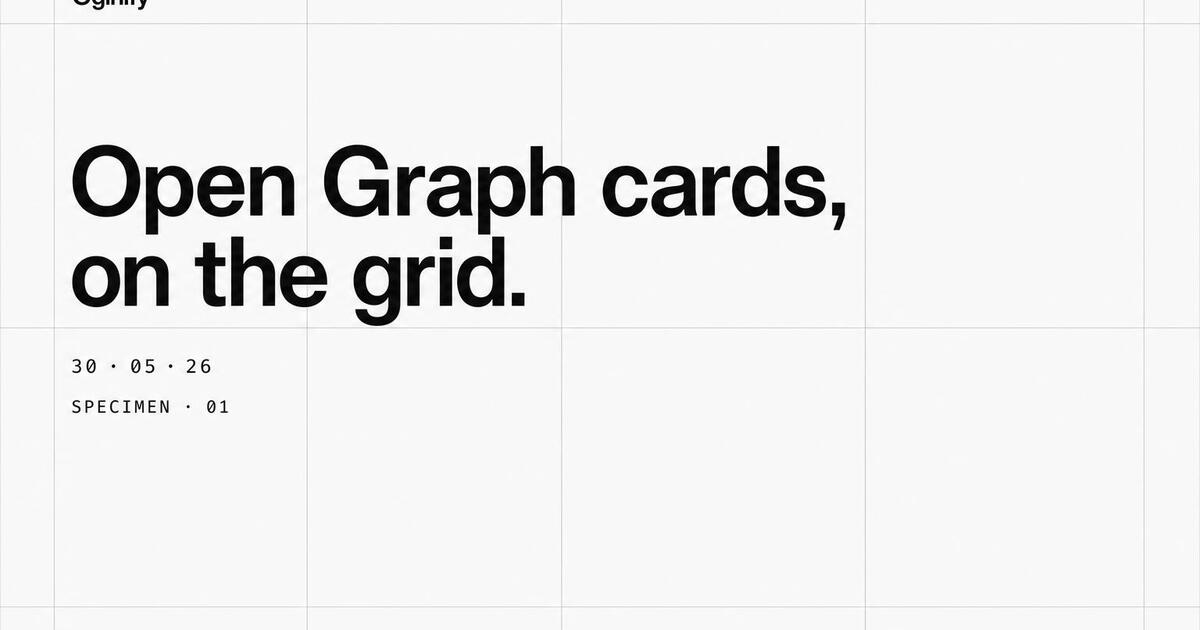
Swiss is the safe choice that's actually a strategic choice, and it sits at the polar opposite of terminal even though both lean monochrome. Below: the grid moves that make Swiss read as credible by default, the enterprise brands shipping it, and the line that separates it from a dev-flavored terminal card.
Twelve-column grid as religion. Neue-grotesque sans (Helvetica, Inter, Geist) carrying every weight. White or off-white canvas with generous whitespace. Left-aligned headlines, mono only for meta and labels. Color used sparingly as data, never as decoration. Hairline rules instead of borders. Composition does the work.
Vercel sets headlines in Geist on a strict grid. Linear's marketing is the textbook modern Swiss site. Stripe's docs and pricing pages turn grid + sans into product clarity. Apple Newsroom keeps the heritage alive at scale. Braun is the analog ancestor every one of these references.
Both restrained, both grid-driven, opposite audiences. Swiss is sans on white, content-first, written for everyone — a CFO can read it. Terminal is mono on dark, dev-first, written for engineers — a CFO bounces. Pick Swiss for evergreen marketing, pricing, and brand pages; pick terminal for changelogs, CLI launches, and infra.
B2B SaaS · stacklane
B2B SaaS sites need to look credible the first time someone unfurls a link in their team's Slack — before the recipient has parsed a single word. Swiss does that work pre-verbally: grid, whitespace, one accent, a Helvetica-derived sans. The visual vocabulary makes the introduction; the headline only has to confirm it.
Fintech · pricing
Fintech buyers are conservative by trade. The card has to telegraph operational seriousness in the unfurl — Swiss does that better than any other preset. Tight grid, monochrome ground, one accent in the brand color, the price chip or APR number set in a clean numerals-aligned figure.
Editorial · The Meridian
Swiss editorial sits in the publication tradition — Bauhaus, Müller-Brockmann, the Bahnhof. The card uses a heading-and-rule typographic system that reads as a piece of editorial design, not a marketing campaign. Use it for publications whose tone is reportorial rather than promotional.
Comparison · vs
Comparison cards need to look neutral — Swiss is the only preset that lands as neutral by default. Two logos, the same optical weight, a thin rule between them, a small verdict chip below. The card converts because it reads as research, not a hatchet job.
The grid, the sans, the whitespace — used right, it signals engineering rigor. Ship it where that signal counts.
Positioning
The homepage card is the wordmark, one line of copy, and disciplined space — nothing else earns the pixel.
Whitepaper
Long-form technical writing gets its cover treatment — Neue Haas Grotesk headline, one KPI centred, a hairline rule beneath.
Feature ship
Vibe-coding platforms preferring quiet, systematic OG ship feature cards that carry one screenshot and one caption.
Weekly digest
The same grid across every issue turns the digest into a recognizable object in inbox previews.
Swiss cards commit to a strict modular grid, one grotesque type, generous whitespace — the visual grammar of Müller-Brockmann and Vignelli.
Set a 12-column grid with a 40-pixel gutter and align every element to it; whitespace is the primary material, not leftover.
Helvetica, Univers, Neue Haas Grotesk — one family, two weights maximum; the discipline is what reads as Swiss, not the specific face.
Headline flush-left at the top-left grid intersection, body flush-left below; no centering, no justification. Ragged edges signal the grid is honest.
BrutalistMagazine editorialTerminal / CLINeo-brutalistText overlayCinematicCollageRisograph
Swiss-minimal OG cards with tight grids, generous whitespace and one accent color.
A layout discipline from mid-century Swiss graphic design: sans-serif type (Helvetica, Neue Haas Grotesk or modern equivalents), tight modular grid, generous whitespace between elements, one accent color, no decoration. The Stripe, Linear and Vercel visual language, applied to Open Graph cards.
For enterprise SaaS, financial services, developer tools with clean brand identity, professional services, and any B2B where 'credible and modern' is the primary signal. Swiss is the safe default — it never reads as 'too weird' but rarely reads as 'memorable' either.
Stripe, Linear, Vercel, Notion, Figma, most enterprise SaaS launched in the last five years. Search their homepage HTML for og:image and you'll see the same pattern: sans display type, generous whitespace, one accent color, no decoration. It's the default of category.
Yes and no. It's the safe default, so every category-competitor card looks similar. That's a problem if you're trying to stand out visually; it's an advantage if your positioning is 'grown-up alternative to the messy incumbent'. Pick Swiss when uniformity IS the brand signal.
Swiss is safe, controlled, uniform. Brutalist is loud, aggressive, opinionated. Same information density, opposite emotional register. Swiss wins on category-competition (looking like a peer of Stripe); brutalist wins on category-differentiation (looking unlike any peer at all). Pick based on positioning.
Legible when the headline is set at 4-6% of the card height (usually 60-90px at 1200×630). Below that, Swiss gets illegible fast at feed scale because there's no visual redundancy — no color, no decoration, no photo — to compensate for tiny type. Keep headline scale generous.
Paste any URL and get four Swiss-minimal 1200×630 Open Graph cards using your brand palette. No signup.