
Drop
Announce Tomorrow Product Drop
The launch tweet and the product URL should both carry the exact SKU render — same lighting, same crop.
Every store link is a tiny pitch — PDPs in DMs, category pages in gift guides, campaign URLs in newsletters. Ship on-brand cards for the whole catalog without installing a Shopify app.
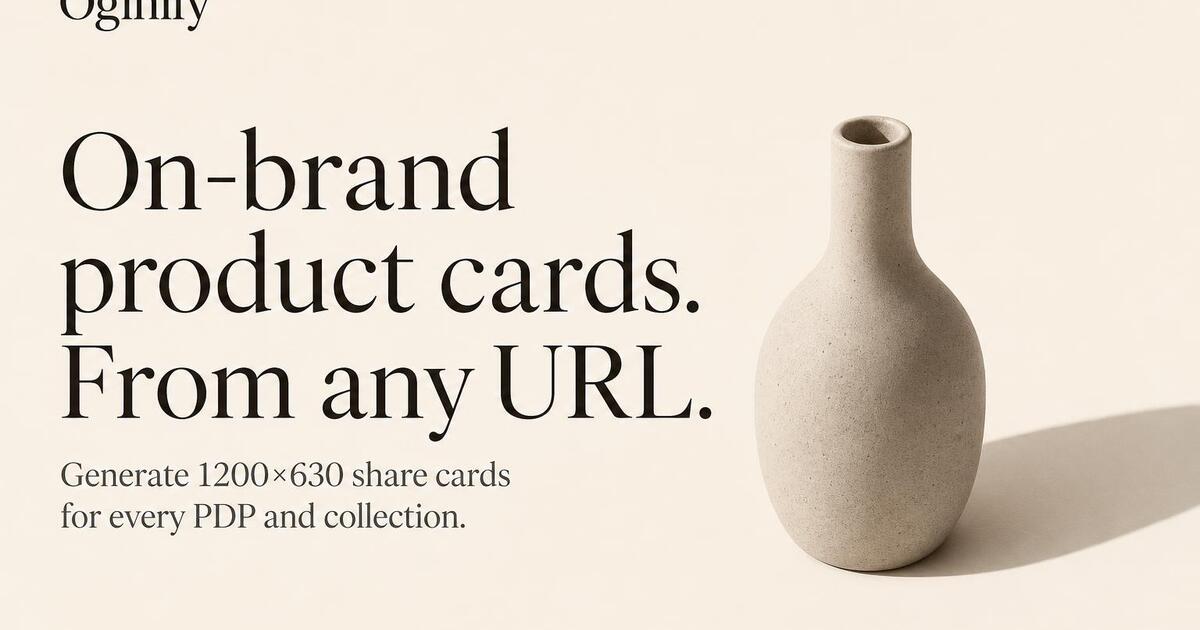
Built for the way DTC and Shopify brands actually ship — per-URL, brand-aware, and free to try without an account or a plugin.
Paste any product URL and Oginify pulls the product name, price, hero photo and brand palette straight from the live page — no PIM export, no CSV, no Shopify app install. The card matches the store, not a generic template.
Most generators stop after one image. Oginify returns one on-brand card plus three creative directions per URL, so you can run it across every SKU and still ship a coherent catalog.
A card that still shows last month's price is a returns ticket waiting to happen. Re-run the URL after a price drop or restock and the image updates in seconds, then validate that every platform serves the fresh version.
The Open Graph and Twitter block ships with everything PDP cards need — width, height, og:image:alt and product:price:amount already filled in. Paste it once into your Shopify theme (or Next commerce, or hand-rolled Liquid) and every product URL on the catalog unfurls with the same fidelity.
Sales, holiday drops and BFCM landings need louder typography than your evergreen PDPs. Every generation includes bolder creative wildcards built for campaign moments.
No Shopify App Store install, no monthly recurring charge, no theme code to fork. Paste a product URL in the browser, four cards land in seconds — keep what works, regenerate what doesn't.
PDP · kestrel & co
Product pages are the highest-intent share on a store — DMs, gift threads, group chats, 'look at this' links. The card needs the product hero, the price and the brand mark in one glance, with enough restraint that it survives a feed full of louder ads. Oginify reads the PDP directly: same product photo, same price, same wordmark. No re-shoot required.
Category · kestrel & co
Category and collection links travel through gift guides, 'best of' roundups and seasonal threads, where one SKU isn't the point — the category mood is. Oginify composes a multi-product card that communicates the range and tone of the collection, so a tableware link reads as tableware before anyone clicks.
Campaign · winter drop
Sale launches, holiday drops and BFCM landings live and die on the first three seconds in feed. Oginify ships a bolder direction for campaign URLs — display-serif typography, dramatic contrast, deadline language — so the link arrives as an event, not another evergreen PDP. Re-run after the campaign ends and the card retires with it.
Homepage · kestrel & co
The root domain is the link people share when they introduce the brand itself — in DMs, on socials, on press lists. Oginify reads the homepage palette, logo and headline and renders the card people see first.
Store URLs get shared into group chats, gift threads and drop announcements. The card should show the product, not the logo.
Drop
The launch tweet and the product URL should both carry the exact SKU render — same lighting, same crop.
Merch
The card is a product shot with the wordmark tucked — a homepage render tells the shopper nothing about what is inside.
Influencer
Solo shops like indie makers running the store alone DM the SKU URL to a creator; the card lands in the story with brand intact.
Inventory
Back in stock should not lag reality by a week on every share — wire the endpoint into the product save hook.
Every SKU deserves a share card — product shot, price, one hook line — so a pasted PDP link converts as hard as the paid ad that drove it.
Pull the primary product photo from the PDP JSON; do not re-shoot for OG. Consistency between listing, PDP and share matters more than novelty.
Price top-right in a fixed chip, one benefit line under the H1 — 'free returns', 'ships in 24 hours' — whichever converts in your ads.
The catalog write hook regenerates the card whenever price, stock or hero image updates, so shares never quote yesterday's number.
SaaS & B2BBlogs & newslettersPortfolios & personal sitesMarketplacesDocs sitesMedia & publicationsEvents & conferences
E-commerce OG cards for PDPs, category pages and campaign landings.
Paste the PDP or category URL. The generator reads the product name, price, hero photo and brand color, and composes a 1200×630 card with the product mark and price front and center. Wire the API into your commerce platform's webhook for auto-generation on new-product publish and price change.
Shopify (via webhook + Storefront API), WooCommerce (via WordPress hooks), Magento 2 (via observer), BigCommerce (via webhook), Ecwid, Squarespace Commerce, Wix Stores. Any platform that emits product-update webhooks and lets you set a per-page og:image works.
Yes when you wire the inventory-update webhook. Every price change or stock-state change triggers a regeneration and the CDN URL swaps. Critical for drop retailers, flash-sale sites and marketplaces where price volatility matters to the share decision.
Only when SKUs differ visually (color, print, material). For same-photo variants that only differ by size, one card per product is enough — the click destination handles variant selection. Pass ?variant=X to the API to generate per SKU when you need it.
Shopify uses the product's primary image, scaled and letterboxed to 1200×630 — no price, no product name overlaid. Oginify composes a purpose-built card with all three (photo, name, price) as separate elements sized for readability at feed scale.
Yes. Point the URL at the campaign landing page instead of a PDP. The generator picks up the campaign hook ('Black Friday', '30% Off', 'New Drop') from the H1 and leads the card with it instead of the individual product.
Paste any product, category or campaign URL and get four 1200×630 Open Graph cards on demand. No plugin, no signup.