
Rebrand
Refresh the Card With Every Story Rewrite
New mission statement, new founding narrative — the card should catch up the same day the copy does.
Your About page carries the founder photo, the origin sentence and the mark that outlasts every rebrand — the share card should carry the same three, not a homepage screenshot
SaaS · stacklane.com
Recruiters, journalists and prospective buyers land on the About page first and share the link. A card that says 'Infrastructure for indie SaaS · founded 2022 · Lisbon' does that intro in one glance; the generic homepage banner buries it.
E-commerce · kestrel & co
DTC brands are the story more than the product. The About card leads with the founder line and one hero photograph — a shopper who shares the About page on Instagram is telling their followers what the brand believes in, and the card has to carry that.
Content & media · the meridian
Publications live on masthead credibility. The About card carries the paper's name in the display serif with the founding year in mono — the share on Twitter reads like a subscription pitch, not a random link.
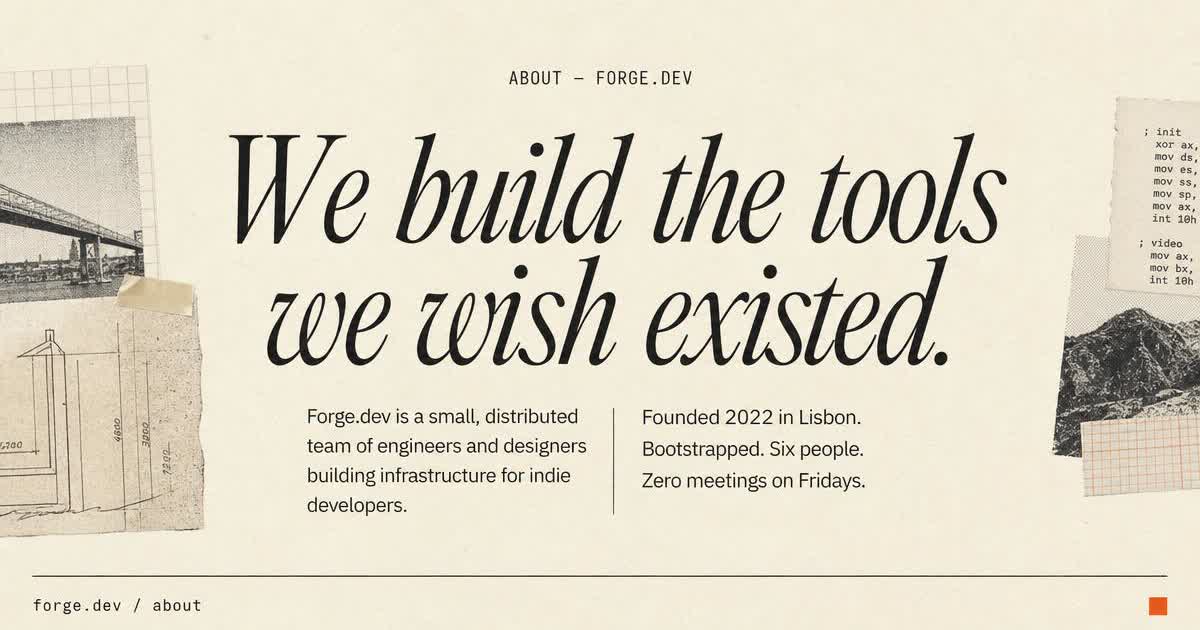
Dev tool · forge.dev
Open-source About pages get shared when a maintainer joins, a milestone is hit or the project needs sponsors. The card renders the mission line in mono with the license and GitHub star count — engineers on Twitter get the pitch without opening the tab.
About pages get shared in press pickups, investor intros and job replies. The card should say who the company is, not just what it does.
Rebrand
New mission statement, new founding narrative — the card should catch up the same day the copy does.
Team
A group portrait or founding photo says more than a stock office render — the About URL earns clicks when the card feels human.
Press
Reporters pasting the About URL into a slug expect the card to carry the founder names and the company mark, not a hero screenshot.
Turn a company story into a shareable card that carries founder photo, mission line and brand palette without landing as a generic team shot.
Extract the sharpest sentence from the About copy — founder promise, origin year or category claim — and let it drive the H1 instead of the company name alone.
Split the frame: photo, sketch or timeline artifact on one side, high-contrast serif or mono headline on the other, brand color as the tie.
Ship a version for press, a version for hiring and a version for social; wire each to the pages that link to them via canonical og:image.
HomepagePricing pagesArticles & blog postsDocs & API referencesCase studies & customer storiesChangelog & release notesComparison & vs pages
Fallback Q&A for hub and category pages that don't yet have a dedicated FAQ row.
Paste your page URL on the homepage. Oginify reads the page and paints four 1200×630 cards in about 30 seconds — no signup, no prompt, no template picker. Download the PNG and paste the ready-made <meta> block into your <head>.
1200×630 pixels at 1.91:1. Every card Oginify outputs hits that spec exactly, so X, LinkedIn, Slack, Discord and iMessage all render the large-card layout consistently.
No. The URL is the entire input for the default entry point. Text-to-OG and image-to-OG entry points exist for cases where a URL isn't available yet.
Yes — 6 image generations per day without an account, no watermark, native 1200×630 PNG. Upgrade for higher daily caps when you need more.
Any framework or CMS that lets you edit <head> or accept a custom og:image URL — Next.js, Astro, Nuxt, Remix, WordPress, Ghost, Sanity, Contentful, Notion, Framer, Webflow, and every static-site generator fed by them.
One sentence, one founding fact, one mark — the About page unfurl becomes a business card instead of a header repeat.