
Ship note
Tie the Card to the Version Number
v3.4.1 goes out on Friday — the tweet, the changelog page and the card all carry the same version stamp.
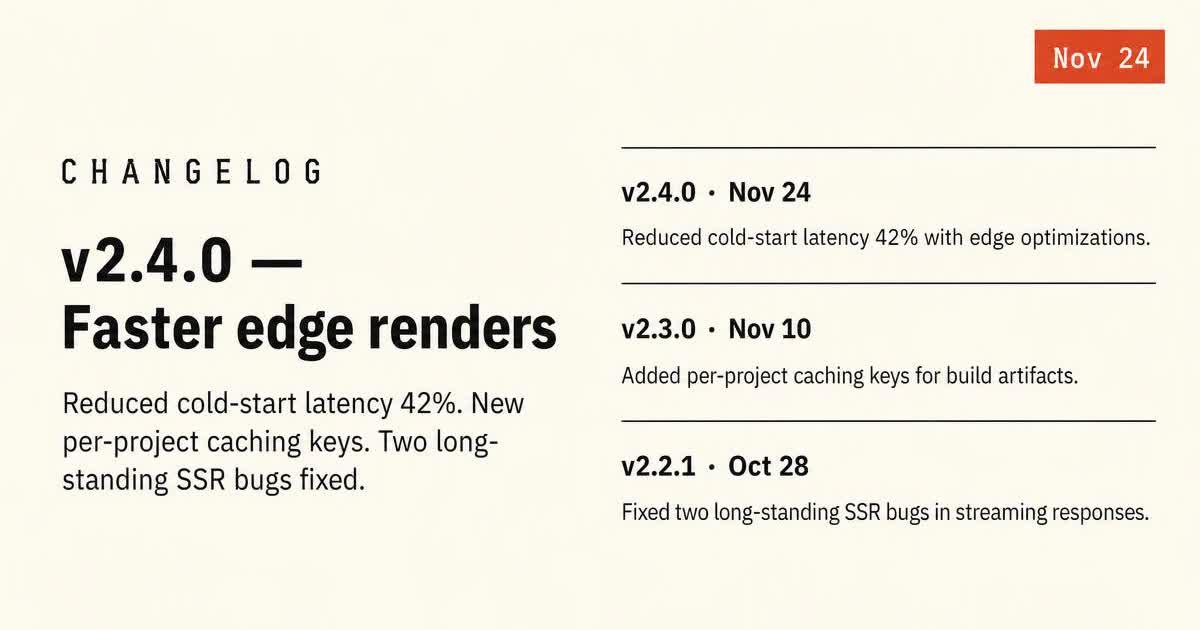
Every version deserves its own unfurl — version tag on the left, date stamp above, one-line summary big enough to read on Slack without opening the link
SaaS · stacklane.com
SaaS changelog links get pinned in customer-facing Slack channels the day a release ships. A card that renders 'v3.2 · Scheduled deploys' in the brand type reads like a real ship-note and earns the click — the generic 'product update' card gets scrolled past.
E-commerce · kestrel & co
New collection drops, restocks and pricing updates ARE the changelog for a store. Oginify treats each drop like a release: date stamp, drop tag, one-line summary in the brand serif — the shopper who opens the email sees the drop framed as news.
Content & media · the meridian
Weekly digests and 'what we published this week' pages are release notes for a publication. The card wears the masthead and the issue number so subscribers on Twitter recognize the digest as part of the paper, not a random link.
Dev tool · forge.dev
An open-source release announced on Twitter has a version tag or it doesn't count. Oginify stamps the semver in mono, adds the date, keeps the headline to one line — the card reads like the git tag itself and engineers upgrade on sight.
Release posts get shared into product-updates channels and dev newsletters. The card should carry the version and the headline change.
Ship note
v3.4.1 goes out on Friday — the tweet, the changelog page and the card all carry the same version stamp.
Deep dive
Big rewrites deserve a headline card, not a generic Whats New banner reused across every release.
Digest
Every changelog entry becomes a row in the digest — the card is the thumbnail readers actually notice in Gmail preview.
Give shipping updates the same care as blog posts — one card per release so a link to v2.4.1 lands with the version, verb and one visible artifact.
Render 'v2.4.1' as a mono chip in the corner; that stamp is how the timeline distinguishes today's ship from last month's.
Headline as active-voice change: 'Faster diffs in Table view', 'Nested comments in Reviews'. Skip 'we are excited to announce'.
One screenshot, one before/after slice, or one API snippet in the composition — proof beats decoration when engineers are the audience.
HomepagePricing pagesArticles & blog postsDocs & API referencesCase studies & customer storiesComparison & vs pagesAbout & company pages
Fallback Q&A for hub and category pages that don't yet have a dedicated FAQ row.
Paste your page URL on the homepage. Oginify reads the page and paints four 1200×630 cards in about 30 seconds — no signup, no prompt, no template picker. Download the PNG and paste the ready-made <meta> block into your <head>.
1200×630 pixels at 1.91:1. Every card Oginify outputs hits that spec exactly, so X, LinkedIn, Slack, Discord and iMessage all render the large-card layout consistently.
No. The URL is the entire input for the default entry point. Text-to-OG and image-to-OG entry points exist for cases where a URL isn't available yet.
Yes — 6 image generations per day without an account, no watermark, native 1200×630 PNG. Upgrade for higher daily caps when you need more.
Any framework or CMS that lets you edit <head> or accept a custom og:image URL — Next.js, Astro, Nuxt, Remix, WordPress, Ghost, Sanity, Contentful, Notion, Framer, Webflow, and every static-site generator fed by them.
Every v-number gets a dated card with the one-line summary, so the Twitter share is the ship-note itself, not a marketing wrapper.