
Publish
Debut the Case With the Client Logo Up Front
The client wordmark, the outcome number, and one visual — that is the card. Not a generic Case Study banner.
Customer stories earn the click on the outcome, not the logo — put the pull-quote and the metric on the card so the click already knows what it is buying before the page loads
SaaS · stacklane.com
Sales reps paste case-study links into cold emails and LinkedIn DMs; a card that leads with '38% conversion lift' and the customer wordmark converts a scroll into an open. The generic 'success story' banner does none of that work.
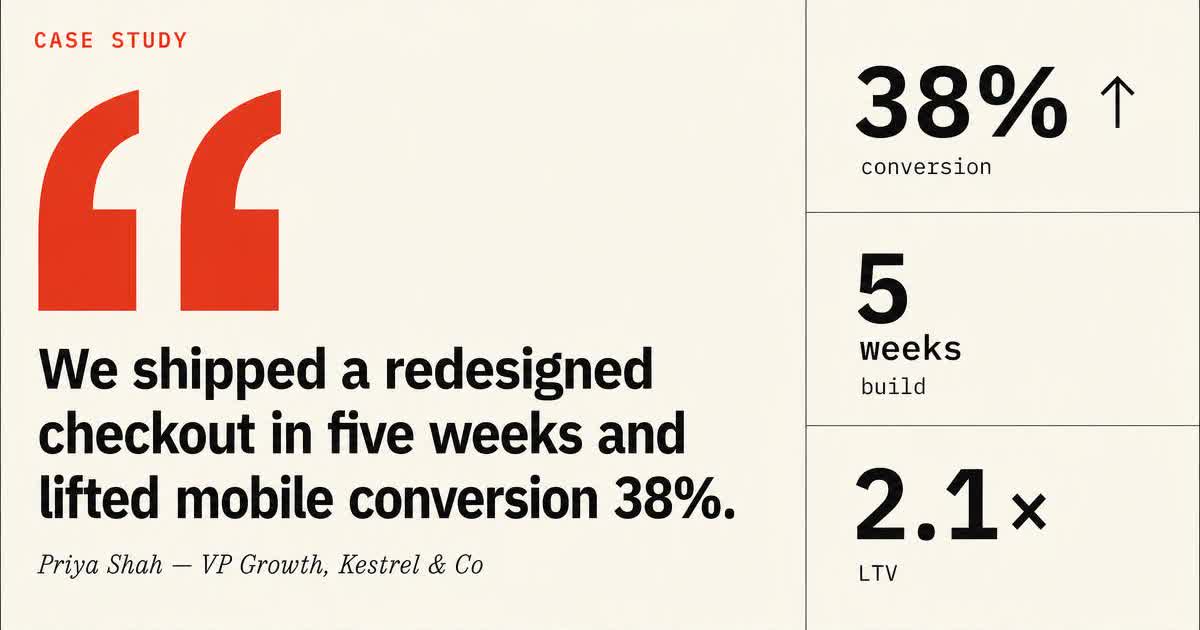
E-commerce · kestrel & co
DTC brands run supplier and maker features that sell the brand story as much as the product. Oginify lifts the pull-quote and the photograph, sets it in the brand serif — the shared card reads as editorial, not as an ad.
Content & media · the meridian
Long-form interviews and profile pieces live and die by the pull-quote that leaks to Twitter. Oginify puts that quote at 60pt with the interviewee's name in the byline rule so the leaked screenshot IS the card.
Dev tool · forge.dev
Engineer-to-engineer testimonials work when they name a real team and a real number. Oginify surfaces the customer engineer's line and the metric ('40% cheaper CI') so a share on Hacker News reads as substance, not marketing filler.
Case studies get pasted into RFP threads, LinkedIn DMs and portfolio decks. The card should carry the client mark and the result.
Publish
The client wordmark, the outcome number, and one visual — that is the card. Not a generic Case Study banner.
Feature story
Editorial case studies deserve a cover treatment — full-bleed hero, subtle byline, the outcome tucked in the corner.
New biz
Agencies like studios pitching branded work every week share the URL in cold outreach — the card is the first line of the pitch.
Rebrand
Client redesigns; their old mark should not linger on your case study card. Re-run the case-study URL after the client's rebrand and swap the image.
Show the customer, the number and the proof surface in one image — the same triad a good sales deck opens with.
Client logo top-left at 24-pixel logo-safe padding; make it the first thing a scroller resolves before the headline lands.
One metric — '3.4× conversion', '$1.2M ARR', '18 → 3 clicks' — set at display weight so it survives the 506-pixel timeline crop.
A single sub-line names the surface: 'checkout redesign', 'onboarding rewrite'. No paragraph, no bullet list — the article body carries the rest.
HomepagePricing pagesArticles & blog postsDocs & API referencesChangelog & release notesComparison & vs pagesAbout & company pages
Fallback Q&A for hub and category pages that don't yet have a dedicated FAQ row.
Paste your page URL on the homepage. Oginify reads the page and paints four 1200×630 cards in about 30 seconds — no signup, no prompt, no template picker. Download the PNG and paste the ready-made <meta> block into your <head>.
1200×630 pixels at 1.91:1. Every card Oginify outputs hits that spec exactly, so X, LinkedIn, Slack, Discord and iMessage all render the large-card layout consistently.
No. The URL is the entire input for the default entry point. Text-to-OG and image-to-OG entry points exist for cases where a URL isn't available yet.
Yes — 6 image generations per day without an account, no watermark, native 1200×630 PNG. Upgrade for higher daily caps when you need more.
Any framework or CMS that lets you edit <head> or accept a custom og:image URL — Next.js, Astro, Nuxt, Remix, WordPress, Ghost, Sanity, Contentful, Notion, Framer, Webflow, and every static-site generator fed by them.
Every case-study URL becomes a card built around the pull-quote and the outcome metric, so the share on LinkedIn is the proof, not a wordmark.